


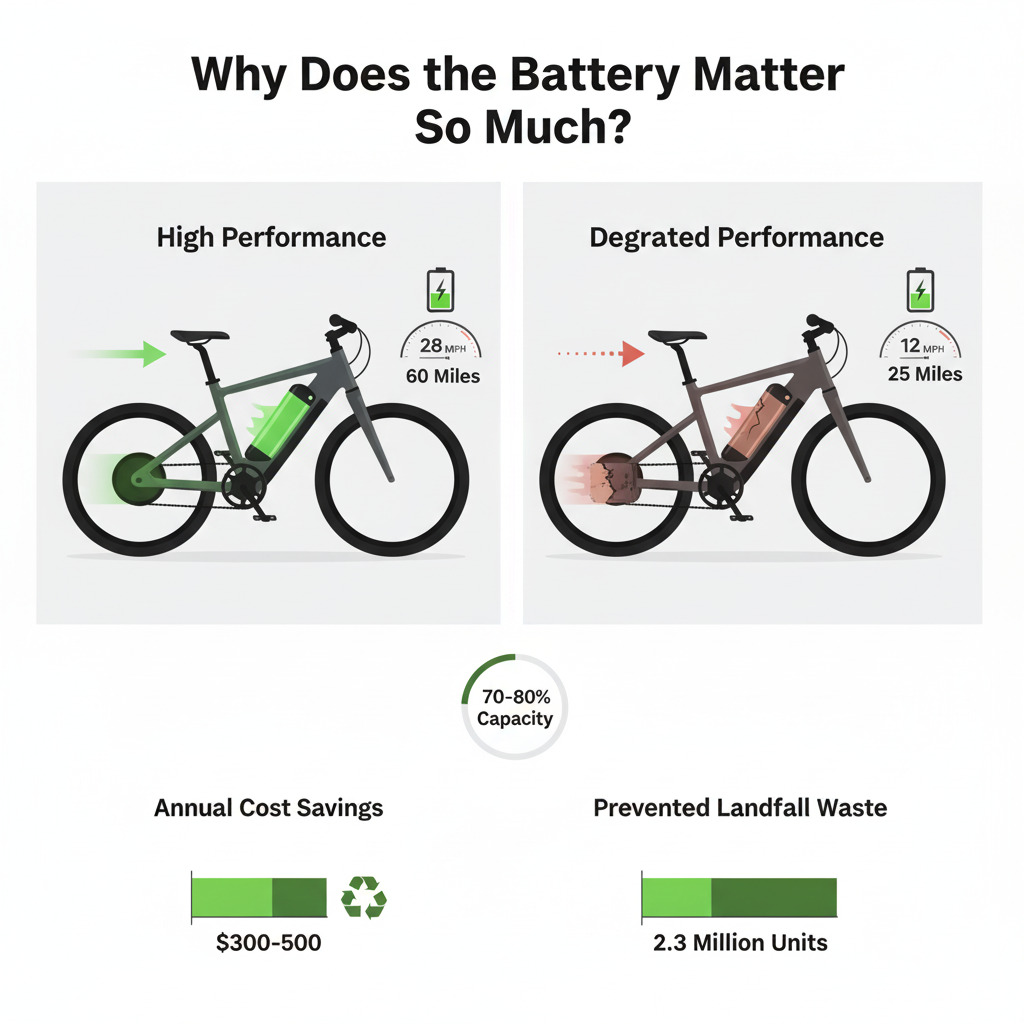
Most electric bike batteries last 3–6 years or 500–1,000 charge cycles depending on chemistry, temperature and care. Lithium-ion ebike battery units degrade gradually through chemical reactions during charging and discharging, typically retaining 70-80% capacity before replacement becomes necessary. Modern electric bike batteries incorporate Battery Management Systems (BMS) that continuously monitor cell health, provide overcharge and over‑discharge protection, and work with proper maintenance practices to significantly extend the operational lifespan of the pack
Battery performance directly impacts your e-bike’s range, acceleration, and overall reliability. Research from Battery University and Bosch eBike Systems shows that proper lithium‑ion battery management—such as avoiding full discharges and storing batteries in cool conditions—can extend battery life significantly, potentially reducing replacement frequency and associated costs.. Understanding lifecycle indicators helps riders maximize their $400-900 investment while supporting circular economy initiatives through responsible recycling.
Why Does the Battery Matter So Much in an E-Bike?
What does ‘battery lifecycle’ actually mean?
Battery lifecycle encompasses the complete journey from initial capacity through gradual degradation to eventual recycling or disposal. Electric bicycle battery life depends on how each lithium-ion cell undergoes irreversible chemical changes during charge-discharge cycles, causing electrode material loss and electrolyte decomposition. Manufacturers rate lifecycles in two metrics: calendar life (3-6 years regardless of use) and cycle life (500-1,000 full charge-discharge sequences).
The lifecycle concept includes capacity fade rate, typically 2-3% annually under optimal conditions but accelerating to 5-8% with poor maintenance. Research from Battery University demonstrates that cells stored at 40% charge at 15°C retain 96% capacity after one year, while those at 100% charge at 25°C drop to 80% capacity.
How does battery health affect performance and range?
Battery degradation manifests through reduced voltage output, increased internal resistance, and diminished energy storage capacity. A battery at 70% health delivers proportionally less power, forcing motors to work harder and drain remaining capacity faster. Range decreases non-linearly: a 30% capacity loss often results in 40-50% range reduction due to voltage sag under load.
Performance indicators include slower acceleration (15-20% reduction at 70% capacity), extended charging times (2-3 hours becoming 4-5 hours), and inconsistent power delivery during climbs. Testing by Bosch eBike Systems shows that degraded batteries experience voltage drops from 42V to 35V under load, triggering protective cutoffs that strand riders unexpectedly.
Who should care most about battery maintenance (commuters, fleet owners, eco riders)?
Daily commuters averaging 20-30 miles face battery replacement every 2-3 years without proper care, representing $400-900 recurring costs. Fleet operators managing 10+ e-bikes report battery expenses comprising 35% of total maintenance budgets, with improper charging protocols causing premature failures across entire fleets.
Eco-conscious riders prioritizing sustainability must balance battery longevity with environmental impact. EPA data confirms that extending battery life from 3 to 5 years reduces carbon footprint by 58% through decreased manufacturing demand and material extraction.
What Types of Batteries Do E-Bikes Use and How Do They Work?
What are the main battery types (Li-ion, NiMH, lead-acid)?
Electric bike batteries primarily use lithium-ion technology, dominating 92% of e-bike applications and offering energy density of 150-220 Wh/kg compared to lead-acid’s 30-40 Wh/kg. NiMH electric bike batteries, comprising 5% of market share, provide intermediate performance at 60-120 Wh/kg but suffer memory effect issues. Lead-acid remains viable for budget models under $500, accepting 300-500 cycles versus lithium’s 800-1,200.
Typical ranges for commercial lithium‑ion chemistries are:
- NMC (Nickel Manganese Cobalt): roughly 180–220 Wh/kg energy density, around 800–1,200 full‑cycle equivalents under typical conditions.
- LFP (Lithium Iron Phosphate): roughly 90–120 Wh/kg energy density, often rated for 2,000 or more cycles to 80% capacity.
- NCA (Nickel Cobalt Aluminum): roughly 200–260 Wh/kg energy density, with many cells delivering on the order of 500–1,000 cycles depending on use.
Based on typical manufacturer and technical specifications for commercial lithium‑ion chemistries, including LiFePO₄ (LFP) storage modules and comparative NMC/LFP/NCA analyses
What do voltage, amp-hours and watt-hours mean?
Voltage (V) determines motor compatibility and power output, with 36V, 48V, and 52V representing standard configurations. Higher voltage enables greater torque and speed: 36V systems peak at 15-20 mph while 52V reaches 28-30 mph. Mismatched voltage destroys controllers within seconds through overcurrent damage.
Amp-hours (Ah) measure battery capacity—the current deliverable over time. A 10Ah battery theoretically provides 10 amps for one hour or 5 amps for two hours. Watt-hours (Wh) calculate total energy by multiplying voltage times amp-hours: a 48V 15Ah battery stores 720Wh, translating to 35-50 mile range depending on terrain and assist level.
How does the Battery Management System (BMS) protect cells?
The BMS monitors individual cell voltages, preventing overcharge above 4.2V or discharge below 2.5V per cell. Temperature sensors trigger protective cutoffs at 60°C, preventing thermal runaway that causes fires. Advanced systems balance cell voltages within 0.05V tolerance, extending pack life by preventing weak cells from limiting overall capacity.
Protection circuits disconnect power during short circuits, overcurrent events exceeding 30-40A continuous draw, or physical damage detection. Testing by UL laboratories confirms BMS intervention prevents 97% of potential battery failures when properly calibrated.
NMC vs LFP: which lasts longer and is safer?
LFP chemistry achieves 2,000-3,000 cycles versus NMC’s 800-1,200, translating to 6-8 year lifespan versus 3-5 years. LFP cells resist thermal runaway below 270°C while NMC ignites at 150°C, making LFP inherently safer for indoor charging. Insurance companies increasingly offer 15-20% premium reductions for LFP-equipped e-bikes.
NMC advantages include 40% higher energy density, enabling lighter batteries (5-7 lbs vs 8-10 lbs for equivalent capacity) and better cold-weather performance (80% capacity at 0°C vs LFP’s 60%). Cost differences narrow as LFP production scales: current pricing shows $250-600 for LFP versus $300-800 for NMC systems.
How to Compare E-Bike Battery Chemistries with an LCOS Calculator (Levelized Cost of Storage)
LCOS analysis divides total ownership cost by lifetime energy throughput. Calculate using: (Purchase Price + Replacement Cost) / (Capacity × Cycles × Depth of Discharge). A $600 NMC battery (15Ah, 1,000 cycles, 80% DoD) yields $0.017/Wh while a $500 LFP battery (12Ah, 2,500 cycles, 90% DoD) achieves $0.008/Wh—half the lifetime cost despite lower capacity.
How Long Do E-Bike Batteries Last and What Affects Their Lifespan?
Do charging habits change battery lifespan?
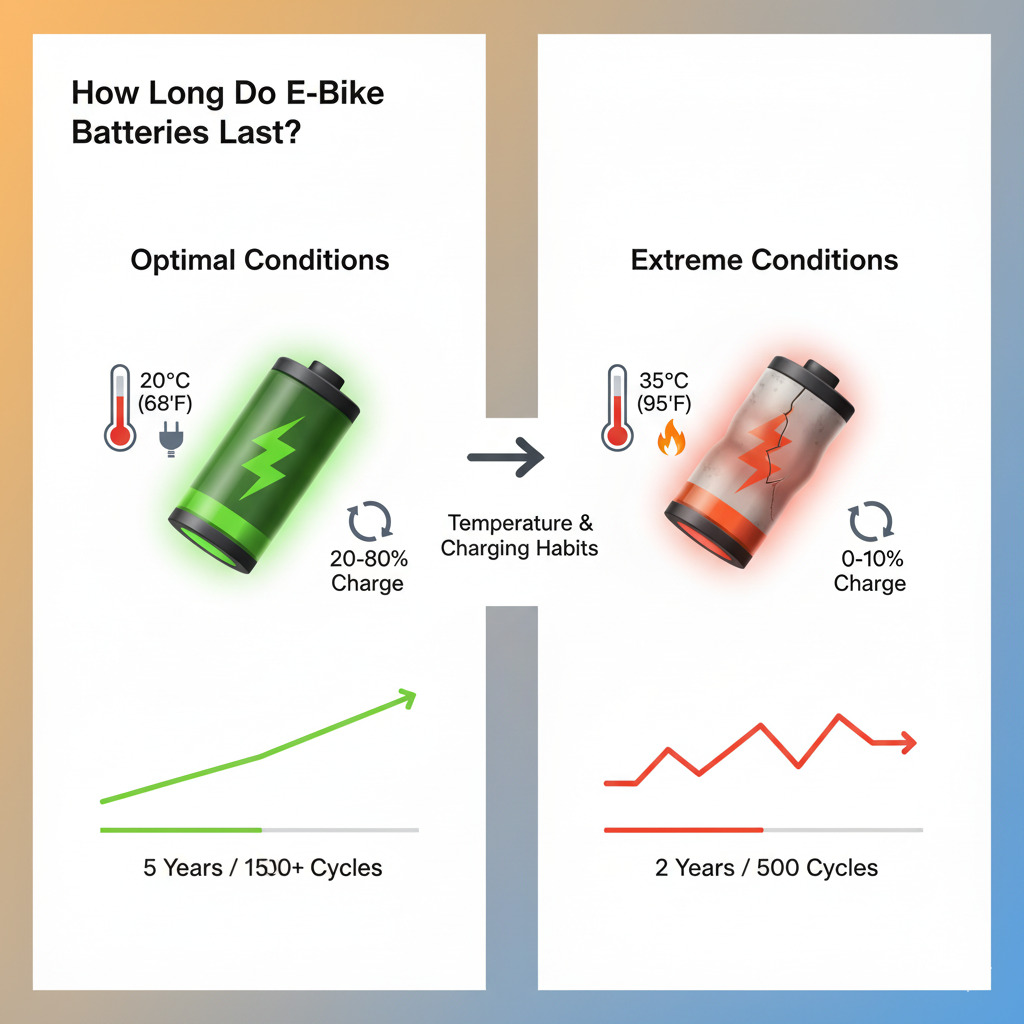
Modern lithium‑ion batteries can achieve significantly longer cycle life when operated within a moderate state‑of‑charge window instead of being repeatedly cycled from nearly empty to completely full, because shallower depth‑of‑discharge reduces stress on the electrodes.
Research from Jeff Dahn’s group and other degradation studies shows that using lower maximum charge voltages and avoiding aggressive full‑range cycling can multiply achievable cycle counts compared with 0–100% use, while very high‑rate fast charging tends to accelerate degradation compared with slower, moderate‑rate charging
How does weather (heat or cold) damage battery cells?
Extreme temperatures significantly affect battery life through accelerated chemical degradation. High temperatures accelerate electrolyte decomposition and solid-electrolyte interface (SEI) layer growth, permanently reducing capacity. Each 10°C increase above 25°C doubles degradation rate: batteries stored at 35°C lose 15-20% capacity annually versus 3-5% at 20°C. Cold temperatures temporarily reduce available capacity (70% at -10°C) but don’t cause permanent damage unless charging occurs below freezing.
Extreme heat above 60°C triggers irreversible damage within hours through separator melting and thermal runaway risk. Learn how to prevent heat-related battery damage in our guide to e-bike overheating and summer riding tips. Winter storage requires 40–60% charge level to prevent deep discharge damage while summer storage demands cool, ventilated spaces away from direct sunlight. Extreme temperatures remain the primary factor that affect battery life beyond normal cycling wear.
How do riding style and terrain affect life expectancy?
Aggressive acceleration and maximum assist levels draw 20-25A continuously, stressing cells beyond optimal 10-15A rates. Hill climbing at full power generates internal temperatures reaching 50-55°C, accelerating degradation by 40% compared to flat terrain riding. Riders using eco mode (5-10A draw) achieve 30-40% longer battery life than sport mode users.
Payload impacts significantly: every 20 pounds of additional weight increases power consumption by 8-12%, forcing deeper discharge cycles. Stop-and-go urban riding with frequent acceleration cycles degrades batteries 25% faster than steady-state cruising at 15-20 mph.
How to Estimate Remaining Battery Life (Use an E-Bike Battery Life Calculator)
Calculate health percentage using: (Current Maximum Range / Original Range) × 100. A battery delivering 25 miles versus original 40 miles operates at 62.5% health. Voltage testing provides precise measurement: fully charged voltage dropping from 42.0V to 40.5V indicates 20-25% capacity loss.
Online calculators factor usage patterns, temperature exposure, and charging habits to predict remaining cycles. Input daily mileage, charge frequency, and storage conditions for personalized lifespan estimates accurate within 10-15%.
How Can You Check Your E-Bike Battery Health?
How to use built-in diagnostic tools or apps
Modern e-bike displays show battery health indicators through bar graphs or percentage readouts, updating after each complete charge cycle. Bluetooth-enabled systems like Bosch Kiox or Shimano E-Tube Project provide detailed analytics including cycle count, maximum temperature reached, and cell balance status.
Manufacturer apps display granular data: individual cell voltages (healthy variance under 0.05V), internal resistance trends (increasing resistance indicates aging), and capacity degradation curves. Export diagnostic reports for warranty claims or resale documentation.
How to test voltage with a multimeter (step-by-step)
- Charge battery fully, wait 2 hours for voltage stabilization
- Set multimeter to DC voltage mode, 60V range minimum
- Locate discharge port or remove battery from bike
- Connect probes: red to positive (+), black to negative (-)
- Record voltage immediately and after 24-hour rest
- Calculate drop: over 0.5V drop indicates internal problems
Safety requires insulated probes, rubber gloves, and eye protection. Never short terminals or probe damaged batteries showing swelling or leakage.
What voltage readings mean for battery health
Healthy 48V batteries (13S configuration) display 54.6V when fully charged, settling to 53.5-54.0V after rest. Readings below 52V indicate 15-20% capacity loss while under 50V suggests immediate replacement need. Individual cell voltage below 3.9V (measured through BMS diagnostics) identifies weak cells limiting pack performance.
36V batteries (10S) should read 42.0V full, 40.5V rested; 52V batteries (14S) measure 58.8V full, 57.5V rested. Voltage sag exceeding 4V under 15A load indicates high internal resistance requiring professional evaluation.
When to get a professional battery diagnostic
Seek professional testing at your local bike shop when range drops below 70% original specification, charging fails to complete within normal timeframe, or error codes appear repeatedly. Technicians at your local bike shop use capacity analyzers performing controlled discharge tests measuring actual versus rated amp-hours.
Professional diagnostics cost $30-75 but identify repairable issues like BMS failures ($100-200 fix) versus cell degradation requiring replacement. Your local bike shop can perform thermal imaging to detect hot spots indicating failing cells, while impedance testing reveals internal shorts before catastrophic failure.
Why Is My E-Bike Battery Dying So Fast and How Can I Fix It?
Common causes (over-discharge, temperature, age)
Deep discharge below 20% triggers accelerated degradation through copper dissolution and lithium plating. Repeated over-discharge events reduce capacity by 5-10% per occurrence. Storage above 30°C causes 15-20% annual capacity loss through electrolyte evaporation and separator degradation.
Age-related decline follows predictable patterns: 5% loss year one, 7% year two, accelerating to 15-20% annually after year three. Manufacturing date matters—batteries lose 3-5% capacity annually even unused, making old stock problematic despite “new” status.
Quick diagnostic checklist before replacement
- Check connections: Corroded terminals increase resistance by 30-50% and affect battery life
- Inspect charger output: Failing chargers deliver insufficient voltage
- Verify display settings: Incorrect voltage settings trigger false readings and affect battery life perception
- Test without load: Disconnect motor to isolate battery issues
- Examine charging port: Debris or damage prevents complete charging
- Update firmware: Outdated BMS software causes premature cutoffs
How to apply the 20-80 rule to extend life
Program chargers with 80% cutoff using smart plugs or timer switches, reducing end voltage from 54.6V to 52.5V for 48V systems. Recharge when capacity reaches 20-30%, avoiding deep discharge stress. This practice helps conserve battery life and extends cycle count from 500 to 1,500+ cycles according to Battery University testing.
Mid-day opportunity charging during work breaks maintains optimal 40-60% state of charge, helping to conserve battery life through reduced stress cycles. Riders report 40-50% lifespan extension using partial charge patterns versus complete cycles.
What Are the Warning Signs an E-Bike Battery Needs Replacement?
How much range loss means it’s time to replace (>20%)?
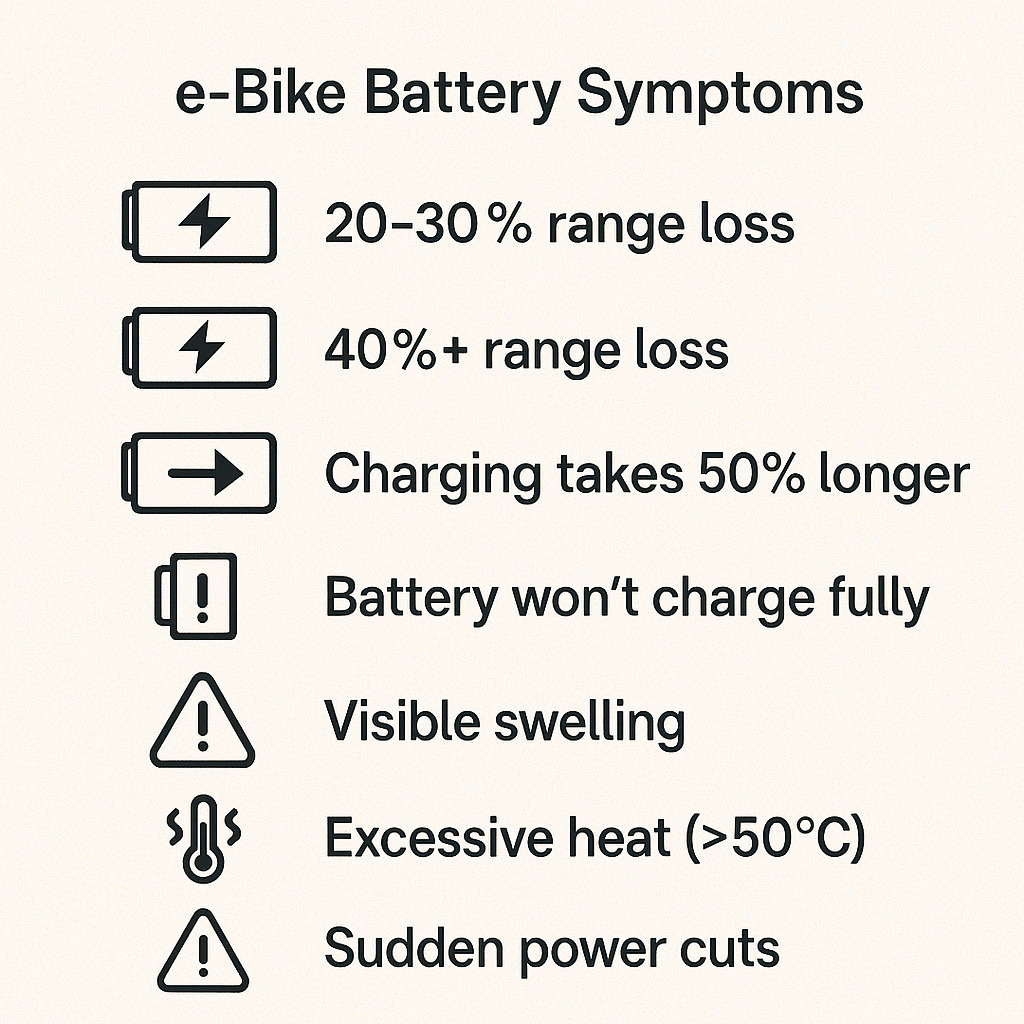
Industry standards recommend replacement when capacity drops below 70-80% original specification. A 40-mile battery delivering under 32 miles requires replacement for practical commuting needs. Commercial operations replace at 80% capacity to maintain schedule reliability.
Range degradation accelerates exponentially: batteries losing 20% capacity in three years typically lose another 20% within 12 months. Continued use below 60% capacity risks sudden failure and potential safety hazards from voltage instability.
Why charging time is getting longer
Degraded cells accept charge slowly due to increased internal resistance and reduced chemical reaction rates. Normal 4-hour charging extending to 6+ hours indicates 25-30% capacity loss. Batteries failing to reach full charge after 8 hours have developed internal shorts or dead cells.
Extended charging generates excess heat, further accelerating degradation. Chargers working overtime consume 20-30% more electricity, adding $15-25 annually to operating costs.
What to do if battery overheats or swells
Immediately discontinue use of batteries showing visible swelling, case deformation, or temperatures exceeding 50°C during normal operation. Swelling indicates gas generation from decomposing electrolyte, preceding potential thermal runaway.
Safety protocol requires:
- Move battery outdoors away from structures
- Place in fireproof container (metal trash can)
- Contact hazardous waste disposal for collection
- Never attempt charging or disassembly
- Document damage for insurance claims
Table of symptoms and recommended actions
| Symptom | Likely Cause | Recommended Action | Urgency |
|---|---|---|---|
| 20-30% range loss | Normal aging | Monitor monthly | Low |
| 40%+ range loss | Significant degradation | Plan replacement | Medium |
| Charging takes 50% longer | High internal resistance | Professional diagnosis | Medium |
| Battery won’t charge fully | Dead cells or BMS fault | Test with multimeter | High |
| Visible swelling | Gas generation | Stop use immediately | Critical |
| Excessive heat (>50°C) | Internal short developing | Discontinue charging | Critical |
| Sudden power cuts | BMS protection activating | Check connections first | High |
| Error codes displayed | Various electronic faults | Consult manual/dealer | Medium |
Is It Worth Replacing an Old E-Bike Battery or Buying a New One?
Average replacement price range ($400–$900)
Generic 48V 13Ah batteries cost $400-550 while OEM replacements range $600-900. Premium brands like Bosch or Shimano command $800-1,200 for proprietary systems with integrated diagnostics. Larger capacities (20Ah+) add $150-300 to base pricing.
Installation labor adds $50-100 unless DIY-capable. Disposal fees for old batteries range $10-25 at retailers not participating in free recycling programs.
When repair or rebuild is a better value
Professional rebuilding costs $300-500, saving 30-40% versus new purchase. Viable when BMS remains functional, casing shows no damage, and bike value exceeds $1,500. Rebuilders replace cells while retaining original housing and electronics, maintaining manufacturer compatibility.
Repair economics favor batteries under two years old with isolated cell failures. Single cell replacement costs $50-100 versus complete pack replacement. Rebuilding extends life 2-3 years, delaying larger investment.
ROI Calculator: Compare replacement vs new bike
Calculate using: (Battery Cost / Expected Additional Years) versus (New Bike Cost / Expected Lifespan).
Example: $600 battery providing 3 additional years equals $200/year. New $2,000 e-bike lasting 6 years costs $333/year. Battery replacement offers superior value unless frame, motor, or drivetrain require simultaneous replacement.
Factor residual value: upgraded battery increases resale by $300-400, recovering 50-60% of investment.
How Much Does an E-Bike Battery Cost to Replace in 2025?
Price by voltage (36V / 48V / 52V / 72V)
| Voltage | Generic Price | OEM Price | Capacity Range | Typical Application |
|---|---|---|---|---|
| 36V | $300-450 | $500-700 | 10-15Ah | City/casual bikes |
| 48V | $400-600 | $700-900 | 13-20Ah | Commuter/touring |
| 52V | $500-700 | $800-1,100 | 14-21Ah | Performance/cargo |
| 72V | $700-1,200 | $1,000-1,500 | 20-30Ah | High-speed/commercial |
Capacity impact (10Ah – 30Ah)
Each additional amp-hour adds $20-40 to battery cost. Upgrading from 13Ah to 17Ah (+30% capacity) increases price by $80-160. Large 25-30Ah batteries for cargo bikes reach $1,000-1,500 due to cell count and specialized BMS requirements.
Energy density improvements allow same-size upgrades: newer 21700 cells pack 17Ah where older 18650 cells managed 13Ah, providing 30% more range without frame modifications.
Warranty and compatibility notes
Manufacturer warranties span 1-3 years or 500-800 cycles, whichever occurs first. Extended warranties add $100-200 but cover replacement if capacity drops below 60% within coverage period. Third-party batteries void frame warranties on some brands.
Compatibility requires matching voltage, connector type (Anderson, XT60, proprietary), and communication protocol (CANbus, UART). Mismatched components cause immediate failure or degraded performance.
Cost savings through refurbished or rebuilt options
Refurbished batteries from reputable rebuilders cost 40-60% of new pricing with 6-12 month warranties. Grade A refurbished units undergo complete testing, cell replacement, and BMS updates. Grade B units offer functional capacity at 50-70% original specification for budget-conscious riders.
Bulk purchasing through group buys reduces costs 15-20%. Local e-bike clubs coordinate annual orders, negotiating dealer pricing for members.
How Should You Charge an E-Bike Battery for Maximum Life?
Typical charging time (2–6h)
Standard 2A chargers replenish 10Ah batteries in 5 hours, 15Ah in 7.5 hours. Fast 4A chargers halve timing but increase heat generation and stress. Slow 1A charging extends battery life by 20-30% through reduced thermal cycling.
Charging efficiency drops 10-15% in final 20%, making 80% charge achievable in 60% of full-charge time. Riders needing maximum range should begin charging 3-4 hours before departure rather than overnight.
Should you avoid charging to 100% every time?
Research published in the Journal of Energy Storage confirms limiting charge to 80-90% doubles cycle life while sacrificing only 10-20% daily range. Full charging remains appropriate for long rides or monthly BMS calibration maintaining accuracy.
Smart chargers with programmable cutoff voltage automate partial charging. Set 48V chargers to 52.5V (80%) versus standard 54.6V (100%). Manual monitoring using outlet timers achieves similar results for basic chargers.
Is it safe to leave plugged in overnight?
Quality chargers with proper certification (UL, CE) include overcharge protection, automatically stopping current flow when batteries reach target voltage. Fire investigation data from the National Fire Protection Association links 85% of e-bike fires to uncertified aftermarket chargers lacking safety features.
Best practices recommend:
- Charging in ventilated areas away from bedrooms
- Using smoke detectors above charging stations
- Unplugging once charging completes
- Never charging damaged or swollen batteries
- Avoiding extension cords or power strips
Best chargers for battery longevity
Programmable smart chargers ($150-300) offer customizable charge profiles, temperature monitoring, and storage modes. Brands like Grin Satiator or Luna Advanced support multiple battery types and voltages.
Features extending battery life:
- Adjustable current (1-5A selection)
- Voltage limiting (80-90% options)
- Temperature compensation
- Storage charge function (50% for long-term)
- Cell balancing optimization
- Charge logging for warranty claims
How Should You Store an E-Bike Battery When Not in Use?
Ideal storage charge (40–60%) and temperature
Store your ebike battery at 50% charge (48V battery at 49-50V) to minimize chemical stress while preventing deep discharge damage. This state of charge loses only 1-2% monthly versus 5-8% at full charge. Temperature between 10-20°C (50-68°F) optimizes chemical stability for your ebike battery.
Basement storage typically provides ideal conditions. Avoid attics (extreme temperatures), garages (contamination), or sheds (moisture). Climate-controlled indoor spaces extend ebike battery storage capability to 6-12 months without degradation.
How often to top up during off-season
Check voltage monthly, recharging when dropping below 40% (47V for 48V battery). Winter storage requires checking every 6-8 weeks while summer storage needs monthly attention due to higher self-discharge rates.
Set calendar reminders for maintenance charges. Batteries forgotten for 6+ months risk irreversible damage from deep discharge, particularly if stored depleted.
Do E-Bike Batteries Drain When Not in Use?
Yes, self-discharge occurs at 2-3% monthly for lithium-ion cells at room temperature. BMS parasitic drain adds 1-2% monthly, monitoring cell voltages continuously. Combined loss reaches 3-5% monthly, accelerating above 25°C.
Older batteries self-discharge faster due to internal shorts and separator degradation. Batteries over three years old may lose 8-10% monthly, requiring more frequent maintenance charging.
Long-term storage checklist and safety steps
Pre-storage preparation:
- Clean terminals with isopropyl alcohol
- Apply dielectric grease to prevent corrosion
- Charge to 50% (verify with multimeter)
- Photograph voltage reading for reference
- Remove from bike to prevent parasitic drain
- Store in fireproof container if available
Monthly maintenance:
- Visual inspection for swelling or damage
- Voltage check (recharge if below 40%)
- Terminal cleaning if corrosion visible
- Temperature verification (move if outside 10-25°C)
- Document readings for warranty purposes
How Can You Prevent E-Bike Battery Fires and Stay Safe?
Why batteries catch fire and how to avoid it
Thermal runaway occurs when internal shorts generate heat faster than dissipation, triggering chain reaction at 150°C for NMC cells. NFPA statistics show 75% of fires result from physical damage, 15% from manufacturing defects, and 10% from improper charging.
Prevention strategies:
- Inspect for damage after drops or crashes
- Replace batteries showing any deformation
- Use only manufacturer-approved chargers
- Maintain 2-foot clearance during charging
- Install ABC fire extinguisher near charging area
- Never modify or open battery housing
Certified vs uncertified packs (UL/CE/IEC)
UL 2849 certification requires passing puncture, overcharge, and temperature tests preventing 95% of potential failures. CE marking indicates European safety compliance while IEC 62133 covers international standards. Certified batteries cost 20-30% more but reduce fire risk by factor of 10.
Insurance companies increasingly require certification for coverage. Uncertified batteries void homeowner policies if causing property damage. Some cities ban uncertified batteries from multi-unit buildings.
Insurance coverage and safety benefits
Specialized e-bike insurance ($100-300 annually) covers battery fires, theft, and damage. Standard homeowner policies exclude e-bike batteries as “motorized vehicle components.” Riders should verify coverage explicitly mentioning lithium battery protection.
Safety investments returning value:
- Fireproof charging bag ($50-100)
- Smart smoke detector above charging area ($30-50)
- Timer outlet for charge limiting ($20-30)
- Fire blanket for emergency response ($30-40)
- Battery storage cabinet ($200-400)
Emergency procedure if a battery smokes or ignites
Immediate response protocol:
- Evacuate all persons from building
- Call 911 reporting lithium battery fire
- Do not use water on energized battery
- If safe, disconnect power at breaker
- Use Class D extinguisher if available
- Ventilate area after extinguishing (toxic fumes)
Never attempt moving burning batteries—temperatures exceed 1,000°C. Inform firefighters about battery chemistry and capacity for appropriate response.
Why Must Voltage Match When Replacing an E-Bike Battery?
Why mismatched voltage can damage a controller
Controllers designed for 48V systems expect 42-58V operating range. Installing 52V battery delivers 44-63V, exceeding component ratings. Overvoltage destroys MOSFETs within seconds, requiring $200-400 controller replacement.
Undervoltage causes different failures: 36V battery in 48V system triggers low-voltage cutoff, preventing operation. Controllers attempting compensation draw excessive current, overheating and failing within hours.
How to read Ah and Wh for capacity upgrades
Amp-hours indicate current capacity: 17Ah provides 70% more range than 10Ah at identical voltage. Watt-hours account for voltage differences: 36V 20Ah (720Wh) equals 48V 15Ah (720Wh) in total energy.
Upgrading capacity requires verifying:
- Physical dimensions fit battery mount
- BMS handles increased current draw
- Charger supports longer charge times
- Motor controller accepts higher sustained current
E-Bike Battery Compatibility Chart (36V–72V Explained)
| System Voltage | Nominal | Fully Charged | Empty | Cell Configuration | Typical Use |
|---|---|---|---|---|---|
| 36V | 36V | 42.0V | 30.0V | 10S | City/leisure |
| 48V | 48V | 54.6V | 39.0V | 13S | Commuter |
| 52V | 52V | 58.8V | 42.0V | 14S | Performance |
| 60V | 60V | 67.2V | 48.0V | 16S | Cargo |
| 72V | 72V | 84.0V | 60.0V | 20S | Motorcycle-style |
Should You Rebuild or Replace a Worn-Out E-Bike Battery?
When rebuilding is safe (BMS intact, no swelling)
Rebuilding suits batteries with functional BMS, intact housing, and 1-3 years age. Professional rebuilders report 80% success rate when original failure stems from cell degradation versus electronic faults.
Avoid rebuilding batteries showing:
- Physical damage or water intrusion
- Burnt components or melted plastic
- Unknown history or uncertified origin
- Proprietary communication protocols
- Age exceeding 4 years
Typical rebuild cost ($300–$800)
Basic cell replacement costs $300-400 for standard 48V 13Ah using generic cells. Premium rebuilds using Samsung or LG cells reach $500-600. Large capacity or high-voltage rebuilds approach $800.
Labor comprises 30-40% of cost. DIY rebuilding saves money but requires spot welder ($200), safety equipment ($50), and electrical expertise. Mistakes cause fires or injuries.
Environmental benefits of rebuild vs new
Rebuilding prevents 8-12 pounds of hazardous waste from entering landfills. Manufacturing new batteries generates 74kg CO2 equivalent while rebuilding produces 15kg—an 80% reduction. Life cycle analysis from MIT confirms rebuilding reduces water consumption by 65% and energy use by 70%.
DIY and professional rebuild options
Professional rebuilders offer warranties (6-12 months), safety testing, and capacity guarantees. Services include cell matching, BMS updates, and performance validation. Turnaround typically takes 5-10 business days.
DIY rebuilding requires:
- Electronics knowledge for BMS programming
- Spot welder for cell connections
- Multimeter for voltage verification
- Safety gear (gloves, goggles, ventilation)
- Fireproof workspace away from combustibles
Can Pedaling or Regenerative Braking Recharge an E-Bike Battery?
How regen systems work and their limitations
Regenerative braking converts kinetic energy to electricity during deceleration, requiring direct-drive hub motors with appropriate controllers. Energy recovery reaches 5-10% in urban riding with frequent stops, less than 3% for continuous riding.
Physics limits efficiency: mechanical braking wastes 60-70% as heat, regeneration captures only 30-40% of remaining energy. Weight penalty of direct-drive motors (15-20 lbs versus 8-10 lbs geared) often exceeds regeneration benefits.
Why most e-bikes don’t trickle-charge while riding
Mid-drive and geared hub motors use freewheeling clutches preventing reverse power generation. Adding generators increases weight by 2-3 pounds and mechanical resistance by 5-10 watts, negating efficiency gains.
Cost-benefit analysis shows regeneration adds $300-500 to system cost while extending range by only 5-10%. Riders achieve better results through efficient riding techniques and proper tire pressure.
Future regen improvements and battery impact
Emerging technologies promise 15-20% regeneration efficiency through improved motor designs and supercapacitor buffers. Advanced BMS algorithms optimize charging during regeneration, preventing stress from rapid current reversal.
Long-term impact remains modest: regeneration extends battery life by 5-8% through reduced discharge depth but increases cycle count through frequent micro-charging events.
How Do You Recycle or Reuse an Old E-Bike Battery?
Why recycling matters (95% material recovery)
Proper recycling recovers lithium (95%), cobalt (95%), nickel (98%), and copper (99%) for new battery production. Research from Argonne National Laboratory demonstrates recycling reduces greenhouse emissions by 58-81% versus virgin material extraction.
Environmental hazards from improper disposal include groundwater contamination from heavy metals, air pollution from incineration, and fire risk in waste facilities. Single battery contamination affects 100,000 gallons of groundwater.
Where to dispose batteries safely (Call2Recycle etc.)
Call2Recycle operates 1,127 drop-off locations nationally, accepting batteries free through manufacturer funding. PeopleForBikes’ “Hungry for Batteries” program partners with Trek, Specialized, and 40+ brands for convenient retail drop-off.
Location resources:
- Call2Recycle locator: call2recycle.org/locator
- Earth911 database: search.earth911.com
- Municipal hazardous waste: Contact local environmental services
- Retailer programs: REI, Best Buy, Home Depot participate
Second-life applications (home storage, solar)
Batteries retaining 60-70% capacity serve stationary storage applications for 5-10 additional years. DIY solar storage systems use retired e-bike batteries for 2-5kWh backup power. Commercial aggregators purchase batteries at $50-100 per kWh capacity.
Conversion requires:
- Inverter compatible with battery voltage
- Charge controller for solar input
- BMS modification for stationary use
- Ventilated, temperature-controlled location
- Professional electrical installation
Mail-in and drop-off program options
Mail-in services provide UN-certified packaging for damaged batteries, costing $25-50 per battery. Ground transportation only—air shipping prohibited for lithium batteries. Prepaid labels available through manufacturer take-back programs.
Drop-off preparation:
- Discharge to 30-50% capacity
- Tape terminals preventing shorts
- Original packaging preferred
- Complete recycling form for tracking
- Obtain receipt for disposal verification
Where Can I Replace or Recycle an E-Bike Battery Near Me ?
If you’re wondering whether to repair or replace an e‑bike battery, scheduling a professional evaluation is a smart first step. Many local shops in Los Angeles provide comprehensive diagnostics, checking everything from battery health and wiring to drivetrain and brake performance, which helps you understand whether repair or replacement is the most cost‑effective option. Services range from basic inspections and tune‑ups to full overhauls of both mechanical and electrical systems, so you can keep your ride safe and reliable. Book ahead to often receive online discounts and personalized service. For expert care and maintenance across all aspects of your e‑bike — including battery diagnostics, tune‑ups, and repairs — visit our Reliable E‑Bike Repair Services page
How Does E-Bike Battery Recycling Help the Environment?
How recycling reduces emissions (−81% GHG)
Manufacturing virgin lithium batteries produces 74kg CO2-equivalent per kWh capacity. Recycled material batteries generate 13kg CO2-equivalent—an 82% reduction. EPA lifecycle analysis confirms each recycled battery prevents 150kg total greenhouse gas emissions.
Water consumption drops 72-88% using recycled materials versus mining operations consuming 500,000 gallons per ton of lithium extracted. Energy requirements decrease 77-89% through eliminated extraction and refining processes.
How recovered metals lower new mining demand
Recycling 1 million e-bike batteries supplies materials for 850,000 new units, reducing mining demand by 85%. Cobalt recovery particularly critical: 70% sourced from Democratic Republic of Congo under questioned labor conditions.
Material recovery rates from professional recycling:
- Lithium: 95% recovery as lithium carbonate
- Cobalt: 95% recovery as cobalt sulfate
- Nickel: 98% recovery as nickel sulfate
- Copper: 99% recovery as refined metal
- Aluminum: 100% recovery from housings
Why proper disposal matters for California EPR laws
Extended Producer Responsibility legislation requires manufacturers funding end-of-life recycling. California SB 1215 mandates battery producers finance collection and processing infrastructure. Non-compliance triggers $10,000 daily fines.
Consumer responsibilities include proper disposal at authorized facilities. Illegal dumping carries $1,000-5,000 fines plus cleanup costs. Documentation proves compliance for warranty claims and insurance purposes.
Which E-Bike Batteries Last the Longest (2025 Brand Comparison)?
Top brand lifespan and warranty comparison table
| Brand | Model Line | Chemistry | Cycle Life | Warranty | Real-World Lifespan |
|---|---|---|---|---|---|
| Bosch | PowerPack/PowerTube | NMC | 800-1,000 | 2 years/500 cycles | 4-5 years |
| Shimano | STEPS | NMC | 1,000 | 2 years | 4-5 years |
| Panasonic | GXO | NMC | 1,000-1,200 | 2 years | 5-6 years |
| Samsung | SDI Series | NMC | 800-1,000 | 2 years | 4-5 years |
| BYD | LFP Series | LFP | 2,000-3,000 | 3 years | 6-8 years |
| CATL | CTP Platform | LFP | 2,500+ | 3 years | 7-8 years |
Most reliable cells by manufacturer
Samsung 35E and LG MJ1 cells demonstrate lowest failure rates at 0.3% within warranty period. Panasonic NCR18650GA achieves highest energy density at 3,450mAh capacity. Sony VTC6 excels in high-drain applications with 30A continuous discharge.
Chinese manufacturers CATL and BYD lead LFP development with 3,000+ cycle ratings. EVE and Lishen provide budget alternatives at 70% of premium pricing with 80% of performance.
Best value battery models for 2025 commuters
Under $500: Unit Pack Power 48V 13Ah ($450) using Samsung cells offers 500-mile monthly range with 2-year warranty.
$500-750: Rad Power Bikes semi-integrated 48V 14Ah ($649) balances performance, aesthetics, and compatibility across multiple models.
Premium: Bosch PowerTube 625 ($999) integrates seamlessly, provides smart features, and maintains 80% capacity after 1,000 cycles with professional support network.
What’s Next for E-Bike Batteries and Future Technology?
What is a solid-state battery and how it works
Solid-state batteries replace liquid electrolyte with ceramic or polymer solid conductors, eliminating fire risk from thermal runaway. Energy density reaches 400-500 Wh/kg versus current 250 Wh/kg maximum, potentially doubling range.
Manufacturing challenges limit current production to laboratory scale. Toyota and QuantumScape project commercial availability by 2028-2030 at 2-3x current lithium-ion pricing, dropping to parity by 2035.
How it extends cycle life and simplifies recycling
Solid electrolytes resist dendrite formation, enabling 5,000-10,000 cycles versus 1,000 for liquid systems. Absence of organic solvents simplifies recycling—mechanical separation recovers 99% of materials without chemical processing.
Temperature stability spans -40°C to 100°C operation versus current -20°C to 60°C limits. Charging completes in 10-15 minutes at 10C rates without degradation.
When riders can expect solid-state options on market
Premium e-bikes may feature solid-state batteries by 2027-2028 at $2,000-3,000 premium. Mass market adoption expected 2030-2032 as production scales. Retrofit kits unlikely due to different charging requirements and BMS incompatibility.
Intermediate technologies arriving sooner:
- Silicon anodes (2025-2026): 20% capacity increase
- Lithium-metal hybrids (2026-2027): 30% density improvement
- Cobalt-free chemistries (2025): 30% cost reduction
- Fast-charge capable cells (2025): 15-minute charging
Frequently Asked Questions
How long does an e-bike battery last?
E-bike batteries typically last 3-6 years or 500-1,000 charge cycles depending on chemistry type, usage patterns, and maintenance. LFP batteries achieve 2,000+ cycles (6-8 years) while standard NMC batteries provide 800-1,200 cycles (3-5 years). Proper care including partial charging and temperature-controlled storage extends lifespan by 30-50%.
How much does it cost to replace one?
Replacement batteries range from $400-900 for standard 48V systems, with OEM options costing 20-40% more than generic alternatives. Budget $500-700 for quality replacement with 2-year warranty. Professional installation adds $50-100 while recycling disposal costs $10-25 at non-participating retailers.
Should I charge to 100% every time?
Limiting charge to 80-90% doubles battery lifespan while sacrificing minimal daily range. Reserve 100% charging for long rides or monthly BMS calibration. Smart chargers automate partial charging through programmable voltage limits.
Can I leave my e-bike plugged in overnight?
Certified chargers include overcharge protection making overnight charging generally safe. However, best practices recommend unplugging after completion and charging in ventilated areas with smoke detection. Never leave damaged batteries charging unattended.
What temperature is best for storage?
Store batteries at 10-20°C (50-68°F) and 40-60% charge level for minimal degradation. Avoid freezing temperatures and heat above 30°C. Basements typically provide ideal conditions while garages and sheds expose batteries to temperature extremes.
Can I upgrade to a higher-capacity battery safely?
Voltage must match exactly—upgrading capacity (Ah) is safe while changing voltage destroys electronics. Verify physical dimensions, connector compatibility, and BMS communication protocol. Higher capacity may require longer charging times.
Do e-bike batteries go bad if not used?
Batteries self-discharge 3-5% monthly, risking deep discharge damage if stored depleted. Check voltage monthly during storage, recharging when below 40%. Batteries unused for 6+ months may suffer irreversible capacity loss.
Can pedaling charge the battery?
Standard e-bikes cannot charge while pedaling due to motor design limitations. Regenerative braking on specialized direct-drive systems recovers 5-10% energy in stop-and-go riding but adds weight and cost exceeding benefits for most riders.
How do I dispose of a damaged battery?
Never place batteries in regular trash. Use Call2Recycle drop-off locations or retailer take-back programs for safe disposal. Damaged batteries require special handling—contact facilities in advance and use appropriate packaging for transport.
What Should You Do Right Now? (Action Plan)
Check your battery health (voltage & range)
Measure fully-charged voltage using a multimeter—readings 2V below specification indicate 20% capacity loss. Calculate actual range versus original specification. Document findings for warranty claims or resale value.
Decide repair / rebuild / replace using ROI calculator
Compare costs: rebuilding ($300-500) versus replacement ($400-900) versus new e-bike ($1,500-3,000). Factor expected lifespan, warranty coverage, and bike condition. Generally, replace if battery exceeds 3 years or bike value under $1,000.
Find a certified recycling center near you
Locate nearest drop-off using Call2Recycle.org/locator or Earth911.com. Confirm acceptance of e-bike batteries specifically. Prepare battery following safety protocols: partial discharge, terminal protection, secure packaging.
Glossary (Ah, Wh, DoD, BMS, LCOS)
Ah (Amp-hours): Battery capacity measurement indicating current delivery over time
Wh (Watt-hours): Total energy storage calculated as voltage × amp-hours
DoD (Depth of Discharge): Percentage of battery capacity used before recharging
BMS (Battery Management System): Electronic controller managing cell balance and protection
LCOS (Levelized Cost of Storage): Total ownership cost divided by lifetime energy delivered
Major Recycling Programs (Call2Recycle, PeopleForBikes)
Call2Recycle operates North America’s largest battery recycling network with 1,127 locations. PeopleForBikes coordinates industry recycling through “Hungry for Batteries” program partnering with 40+ manufacturers.
Regional Regulation Summary (US, EU, California EPR)
US regulations vary by state with 15 states banning landfill disposal. EU Battery Directive mandates 65% recycling rate by 2025. California SB 1215 requires manufacturer-funded recycling infrastructure with compliance tracking.
This guide was developed using a combination of verified public safety data, manufacturer documentation, and community-tested tips from real riders. Sources include official fire incident reports (e.g. FDNY), product manuals and thermal guidelines from Bosch, Shimano, and Rad Power Bikes, as well as safety bulletins from the Consumer Product Safety Commission (CPSC).
To ensure clarity and consistency, AI-assisted tools were used for content structuring and editing, but all information was researched, reviewed, and fact-checked by a human. Real-world advice and user-submitted techniques from forums like Reddit were included to provide practical, field-tested solutions.
Every effort was made to prioritize accuracy, safety, and usefulness for readers navigating hot-weather e-bike challenges.

Great article. Thank you.